Janne Malmisaari
•
Published
22.10.2026
•
18 min read
In short
Nearly 200 HR and talent acquisition professionals registered for our webinar on October 21, 2026. The topic was simple to state, yet hard to answer: where will AI take the applicant tracking system next?
The webinar was hosted by TalentAdore's Marketing Manager Janne Malmisaari (and former recruiter) together with Oskari Valkama, our Head of Product. Below you will find the key points, the live poll results and the questions you sent us. Watch the full recording first, or skip to whatever interests you.
“The buzzword around AI and development work is taste. With AI, it's very easy to lose taste, and everything feels like AI slop. So the question is how you make what you build provide value.”
AI has been a trendy topic for a few years, but the shift underneath it is bigger than a trend. Research from METR found that the length of tasks frontier AI models can complete has doubled roughly every seven months, and the pace may have picked up since 2024. Software development shows the effect most clearly: the 2025 DORA report found that 90 % of developers already use AI tools at work.
Oskari sees it in daily product work. In 2023 and 2024 new models arrived every few months. Now they arrive almost every week, and it is no longer a handful of vendors setting the pace. Open-source models have made it possible to build a stack of models, so you can pick one that is fast, one that is strong in a certain language and one that handles a specific task.
“The buzzword around AI and development work is taste. With AI, it's very easy to lose taste, and everything feels like AI slop. So the question is how you make what you build provide value.”
For recruiters the practical consequence is easy to see. As Oskari puts it:
“We can do the same amount of work that used to take two to three weeks in one week, or even less.”
Ideas that sat on the “maybe someday” shelf reach a proof of concept quickly, and an ATS feature that is not on the roadmap today can show up next quarter. Smart interview scheduling, running a hire in several languages without in-house language skills, and truly competency-based AI matching were all roadmap wishes a few years ago.
We opened the first Mentimeter poll with one question: which AI use case will grow the most in your hiring over the next 12 months? Twenty-seven answers came in from 22 participants.

Screening got the most mentions, followed by headhunting, sourcing and removing manual work. The rest ranged from note taking and scheduling to candidate feedback, first drafts, market intelligence and a “recruitment agent”.
Janne's reading was clear: most of the answers point at the time-consuming bottlenecks of recruitment, the same ones that frustrated him as a recruiter before generative AI. Oskari added the idea of a sparring partner inside the software, for example one that benchmarks salary levels in Sweden, Finland or Germany so you do not have to research them by hand:
“Kind of having a sparring partner inside the software that can help you a lot with things.”
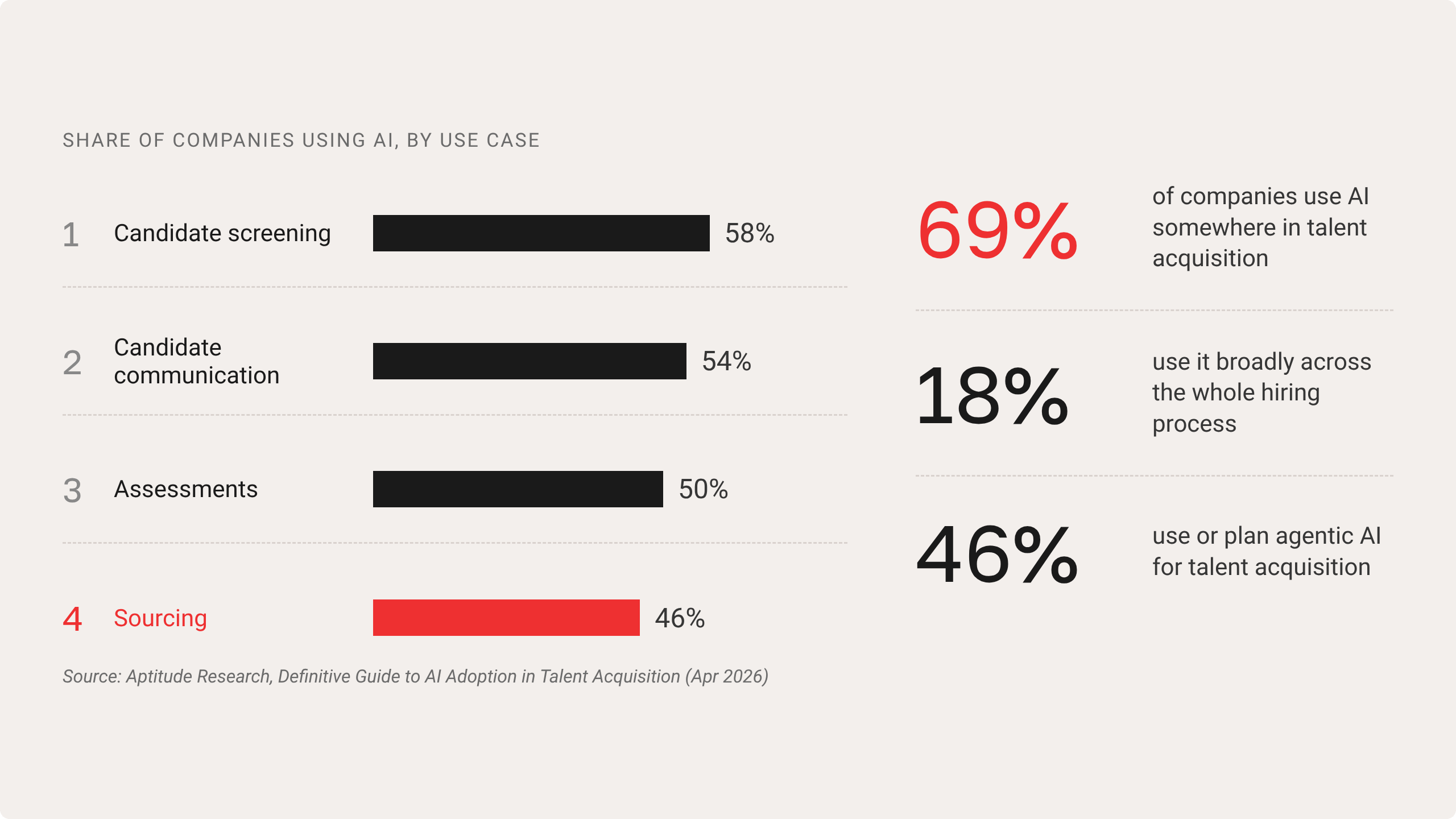
Where does the real adoption stand today? According to Aptitude Research, 69 % of companies use AI somewhere in hiring, but only 18 % use it across the whole process, and 46 % say they use or plan to use agentic AI. Oskari is cautious about that last figure. In his experience, truly agentic AI in recruitment is still rare today, but he expects a shift soon:
“I'm a bit hesitant on that number. I believe in the next year, agentic AI will take over a significant part of the normal work that we do. Maybe it is over-optimistic as a number, in my opinion.”
Four use cases came up in the discussion:
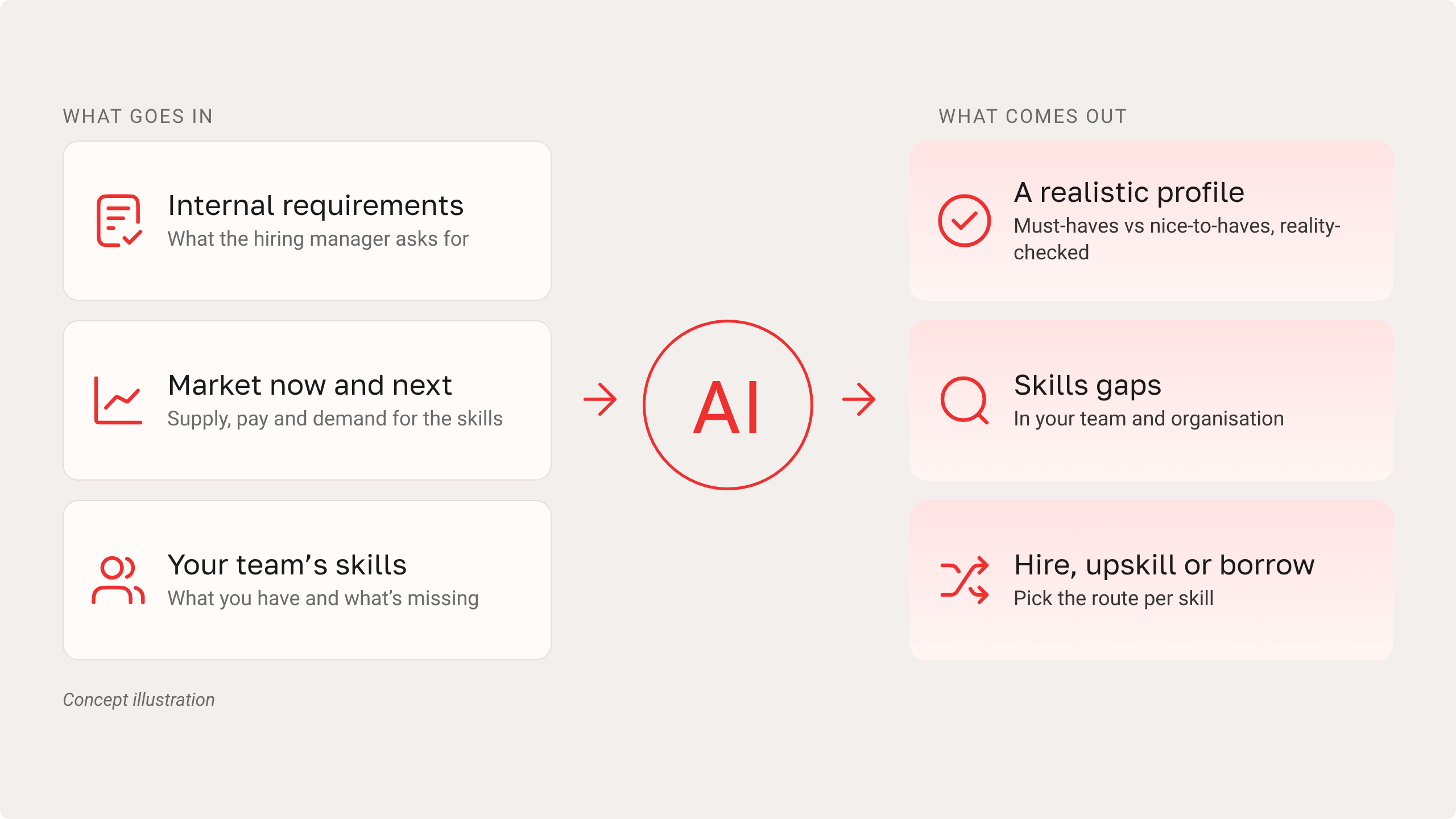
AI-assisted profiling. Before writing a job ad, AI can combine three things: what the hiring manager asks for, what the market offers (supply, salary, competition), and what the team already has. The result is a more realistic profile and, as Janne put it, less urge to hunt for unicorns. Oskari has seen the same pattern with customers: the first search round used to be spent finding out whether the profile was right, and only the second round brought results. Good market data can cut the number of rounds, especially in niche roles. AI can also tell which skills are easy to train, so the hire gets productive faster.
AI skills matching. When you screen hundreds or thousands of applications, AI can surface the supporting skills that most other applicants do not have. Oskari brought up structured matching built on the European ESCO framework.
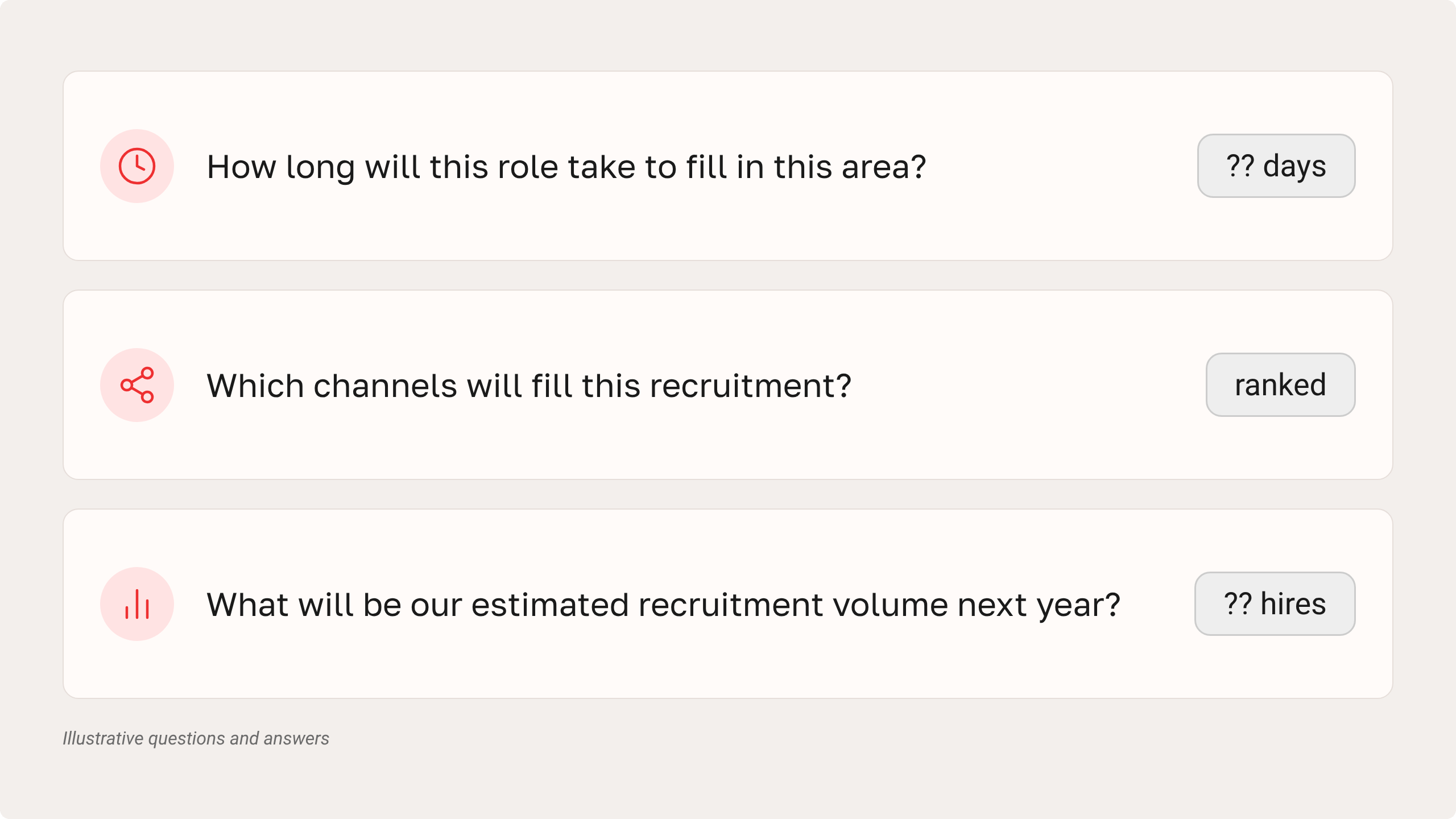
Predictive analytics. Predicting how long a role takes to fill, which channels will work and how many hires next year will need, which matters in budget season. Oskari pointed out that experienced recruiters already do this in their heads: “A recruiter with 15, 20 years of experience has a gut feeling for how it will go. They have their own predictive analytics inside their brain.” AI helps newer colleagues, warns when a job has too few applicants based on history, and lets a manager ask for the rundown without pinging a recruiter. The catch is data quality: in a Deloitte study, 83 % of 924 companies rated their people-analytics capabilities as low, and AI has little to predict from weak data.
AI sourcing is another use case that is already prevalent in talent acquisition, but will only develop and get normalized in the near future. Finding passive candidates is important in any talent market, and with AI, sourcing can be done from LinkedIn and job boards to the talent already sitting in your own system. What will differentiate companies and recruiters is how you combine high-quality, personalized outreach and large volumes: when anyone can reach candidates easily, it is important to stand out to the candidates.
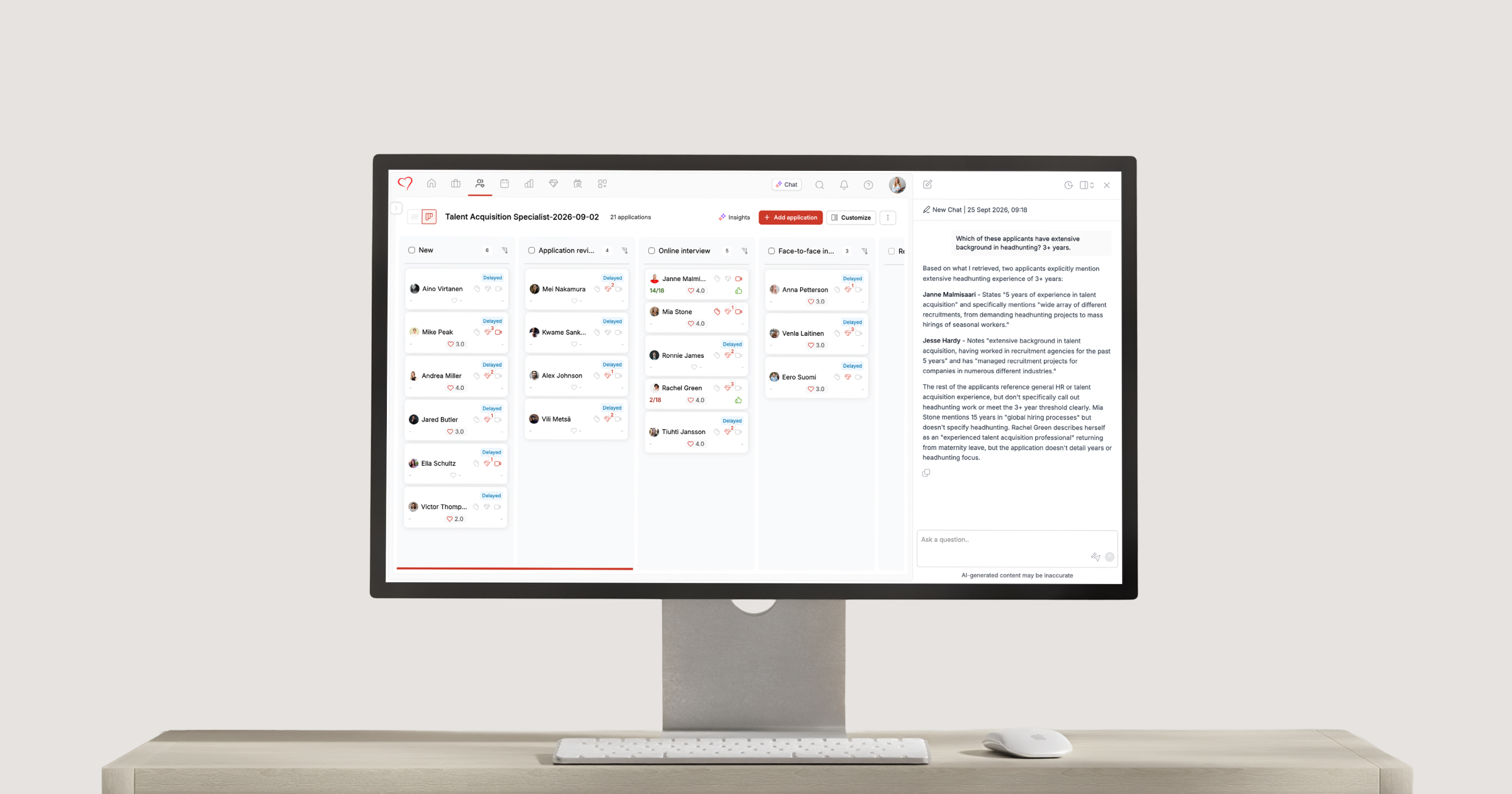
Think about a normal Tuesday in a traditional ATS: open the system, find the position, open candidates one by one, read the CV, click through tabs, check the notes, open email, copy and paste. With a conversational interface, the reality looks very different: you just ask, and the AI does the searching. You then ask follow-up questions and dig into the data.
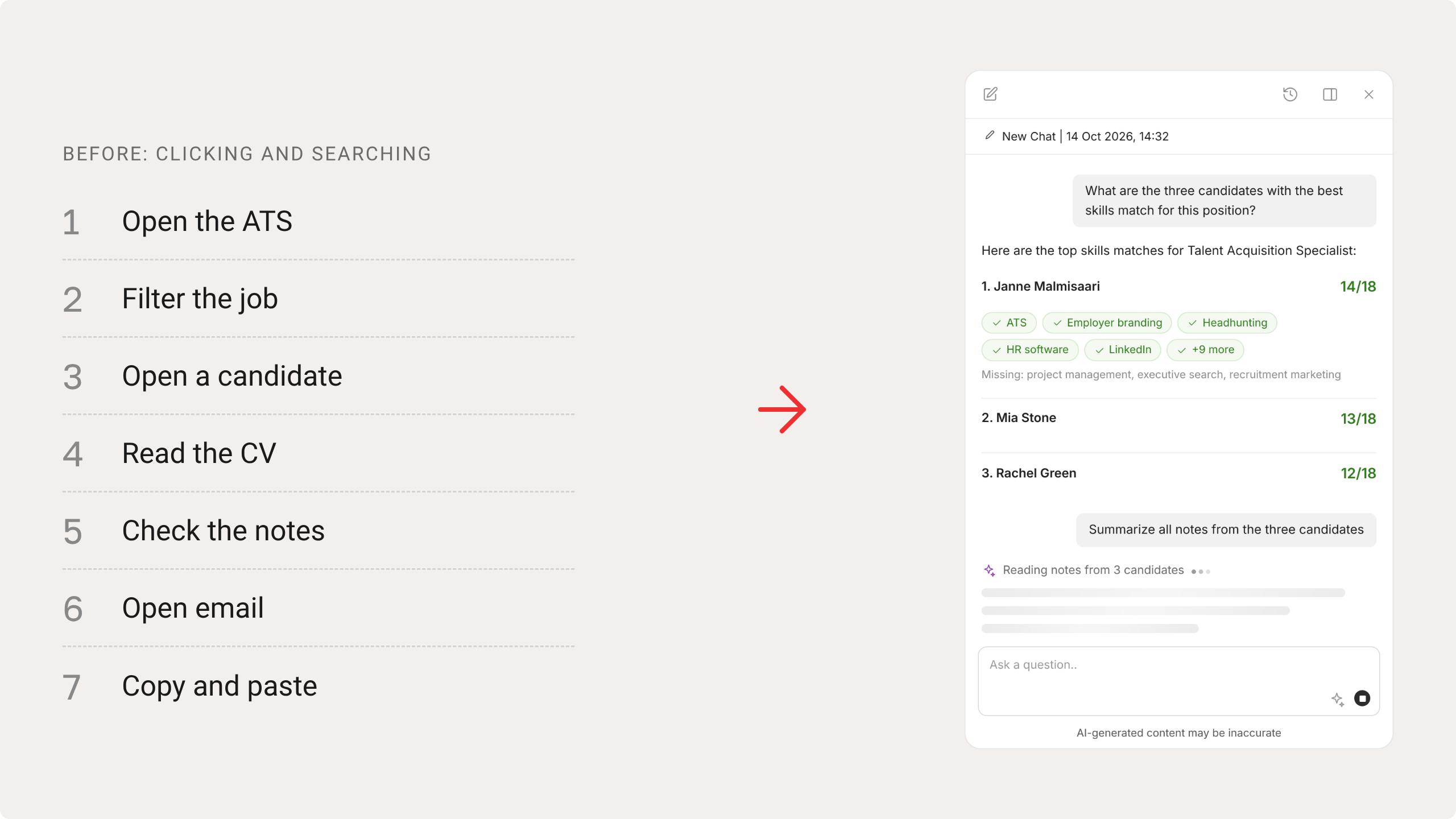
Oskari pointed to a second group of beneficiaries: “Hiring managers sign into the software once a year, and they don't remember how it works.” With a conversational interface they can tell the AI what they want to do, and it does it on their behalf. “For recruiters, it is a power booster”: while screening, you can say “send an interview invite to every candidate I move to this bucket”, and the AI checks with you (“did I do the right thing?”) before moving on.
Janne added a caveat from his recruiter days. Screening is partly visual: you look at how candidates word things and what they convey, and he would not want everything summarized into plain text. Conversational AI should leave room for spending time in the interface too.
There are two ways to get there.
Oskari explained MCP as the USB-C of AI: a common connector, basically an API built for agents, so that AI tools know how to fetch and use your data. (Janne announced he would steal that line.)
Both routes work, but they come with different homework. Oskari's main concern about the headless route is GDPR:
“It doesn't cover your GDPR duties. If you move candidate data to Claude or ChatGPT, you need to remember which chat you used that candidate's data in.”
A candidate has the right to ask for all the data you hold about them, and to have it deleted. Inside an ATS the data stays inside the ATS. With external assistants, and also with external note-takers, it lies in many places, and deletion becomes a detective story. Oskari knows it from his own desk: “I'm personally having hundreds of discussions every week with my AI. If you asked me which conversation I used for this topic, I would have a difficult time remembering.”
He also noted that many ATS vendors state they take no accountability for what you do with an MCP connection, so it is up to you as the user. An enterprise license helps, but it does not answer the question of where you used the data.
Six questions to ask before you run recruitment in Claude, ChatGPT or another assistant:
Janne also raised shadow AI: many office workers use AI tools their employer has not provided, which is a data security question as much as a policy one.
Oskari described one safeguard TalentAdore uses: a small local model strips personal data before anything goes to a larger language model, and data is not moved all at once. A basic MCP connection, he noted, moves everything, including the candidate's name and address, so the AI may become biased. Not all data should be moved for a given piece of guidance or decision.
One thing persists: how a model is trained, and what it is fed, matters even as the technology advances.
“The aim is having a recruiting intern or recruiting manager inside the software as your sidekick.”
TalentAdore has chosen the conversational route with AI inside the system. Instead of many single-purpose functions, Taika, our AI assistant, can open a job and ask you questions to fill it out, schedule interviews, write notes and act on your behalf. Around it sit specific tools such as the AI Notetaker and ESCO-based skills matching.
“The aim is having a recruiting intern or recruiting manager inside the software as your sidekick,” Oskari portrayed.
TalentAdore Hire’s AI as built-in control: admins can switch AI features completely off (for example candidate summaries) and can limit features based on user roles. Customers typically start with the Notetaker and smaller features and move on to the conversational interface over time.
TalentAdore’s AI Service Hub’s safeguards include private LLMs, human in the loop and limiting how much data moves. And an important factor is that Taika suggests, never decides: the user makes the final decision.
Once AI is part of your daily workflow, your role changes. In Janne's words, you become the team lead of your own little digital recruitment assistants. The loop is simple: define the goal and the guardrails, delegate, review the output, and own the decision. Janne's rule is clear: “Under no circumstances let them make any screening or rejecting decisions.”
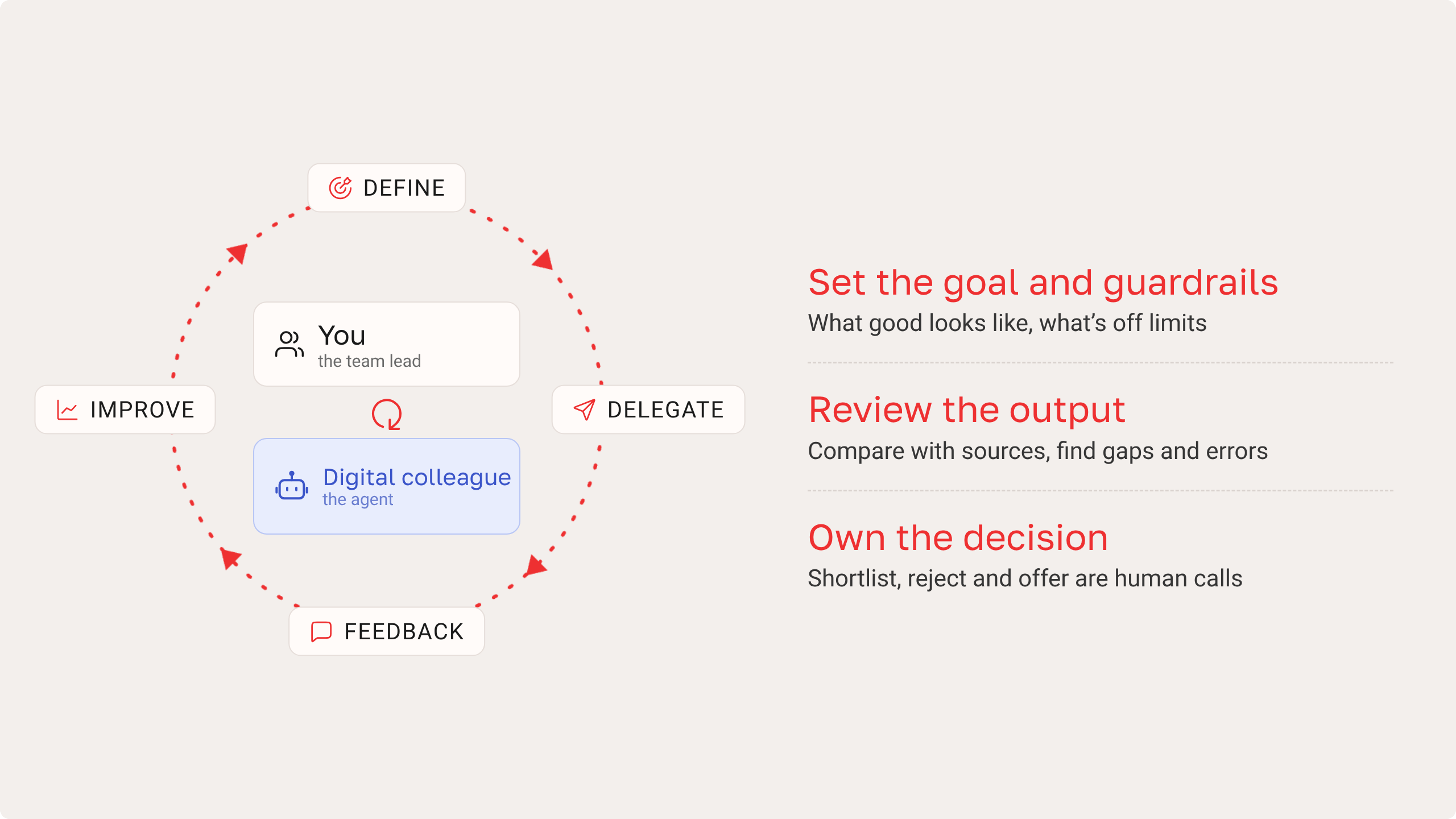
Oskari recommends thinking of AI as a new colleague.
"You should view AI as, not a tool, but a colleague that can do something on your behalf and empower you to do much more than you are able to do today. Give it a clear task, say what you do not want, check what it produces and then decide."
His rule of thumb:
“Give AI your routine work, and keep the human work where you need to be at the wheel.”
There is a trust barrier. In Oskari's experience, you need to try a handover a few times, but it pays off, for example with interview scheduling: “Once you've given it to AI two or three times, you'll realize: no-brainer.”
Hand to your digital colleague: scheduling and reminders, notes, transcripts and summaries, translations and multilingual recruitment, first drafts of messages and job ads, finding contacts and context across systems, and skipping the filters and the tens of tabs.
Keep it human: shortlist, rejection and offer decisions, conversations and feedback with candidates, setting the criteria and guardrails, edge cases, and challenging what the AI says.
Why bother? LinkedIn's Future of Recruiting study reports that teams using generative AI save up to about 20 % of their work week. That figure is self-reported, but it still adds up to roughly a day a week. The better question is where the saved time goes. Our view is that it should move recruitment from reactive to proactive: building pipelines before the requisition opens, putting time into candidate relationships and assessment, and personalizing outreach where you used to send generic messages.
AI systems used in recruitment and worker evaluation are classified as high risk under the EU AI Act, which makes responsibility a shared matter: the vendor carries part of it, and how you use ATS features and third-party tools carries the rest. The timeline has moved. The Digital AI Omnibus (Regulation (EU) 2026/1744, in force since July 27, 2026) postponed the high-risk obligations for recruitment from August 2, 2026 to December 2, 2027. That is more time to prepare, not less to prepare. The prohibitions already apply:
Janne flagged the one that tempts recruiters most: pasting a long list of candidates into an AI tool, asking for a shortlist and trusting the output as is. Oskari's advice followed:
“If your system is built around automated decision-making, ask your vendor directly how they approach these laws. And since AI makes mistakes and can hallucinate things that make a candidate look better than they are, a human in the loop will be needed for the foreseeable future.”
You can learn more about the EU AI Act and recruitment in our full write-up.
The second poll put a statement to the room: “An interview conducted with AI is a humane and responsible way to meet a job applicant for the first time.”

The average landed at 1.9 out of 5. That is close to the 2.0 we saw in our June webinar on responsible AI. Oskari is torn. Someone has spent real time finding a job that matters to them and expects a human to talk to. At the same time, a customer who receives thousands of applications per position could interview many more people with AI, which might be fairer. His conclusion: both sides have a point, and the experience is not great yet.
The candidate side is louder. In a 2026 survey of 2,950 job seekers (US, UK, Ireland, Germany and Australia), 63 % had been through an AI interview and 38 % had walked away from a process because of one. The common thread in the horror stories is that the candidate did not expect an AI interviewer. If you do use one, say so up front.
Bad automation reflects on your employer brand. Janne showed examples of a prompt left visible in a rejection email and a rejection that arrived during the interview, and Oskari told an anecdotal experience from his close circle:
“A person I know got a rejection email from the ATS two months into the job they had been hired for.”
Outreach is the same. It has never been easier to message hundreds of candidates, but speed and mass do not make the message good. Oskari proposes a middle ground:
“Template the message and leave deliberate slots for personalization, such as the skills this candidate is best at. When you have 600 people to email, that keeps the message on brand and still shows a human put thought into it. Candidates know that automated and AI-assisted messages exist. What they notice is whether it lands for them.”
AI Skills Matching is a good example of AI being a good sparring partner, but never an independent decision maker. Ask AI to rank candidates and you get a neat list, so challenge it. Four questions before you trust a score:
Oskari's addition on point three: this is the direction many software products are heading, and 2027 will bring a big change: “Clicking and buttons and knowing where to click will go away in due time.”
You sent plenty of questions, and we answered as many as we could live. Here is a wrap-up.
Q: There are many screening automation products, but I have yet to see AI across the full recruitment lifecycle. Is there any?
Oskari's answer: That matches what the research shows: most tools use AI in specific places. Our aim with Taika is to embed AI in the whole flow and help with any part of the process.
Q: Can AI screen the old applicants already stored in the system?
Oskari's answer: Yes, that is where Taika can help. It works with your own user access, so if you have access to other jobs it can highlight your candidates there. A more sophisticated matching feature is in the works.
Q: Will AI replace recruiters?
Oskari's answer: “I'm not a fortune teller, but I don't think the role as such will go away.” The law is clear that someone must review and accept, change or make the AI's decisions. “What AI will do is make you much faster,” which frees time for work that was not possible before, such as communicating with candidates.
Q: How do you avoid bias?
Oskari's answer: By limiting the data passed to AI. For a candidate summary, name, location, email and phone number are irrelevant, so you pass on only what the person has done. On top of that you build gates and guidelines for what the AI may and may not do. In Oskari's words: “Around 98, 99 % of the time the AI is willing to follow those guidelines. At the times that it's not, you need to stop it before it does anything else.” That is why checkers need to be in place.
Q: In the US, an AI screening vendor has been drawn into a class action over automated rejections. Is there a gap between how the responsibility of AI-based ATS systems is viewed and how the law is applied?
Janne and Oskari's answer: There are plenty of gray areas and few case examples so far on how legislation handles these questions, and every vendor interprets them differently. Oskari: “At TalentAdore, we have decided to be very strict on where we draw the line.” The decision always stays with the user: “By the end of the day, who you hire and who you reject is a human input, and we will make it that way now and forever.” Janne added that not everything comes from legislation: ask what your promise to candidates is. “Sometimes you need to sacrifice some efficiency to be human, but with the new technology you don't have to make as many compromises.”
Q: Candidates write short CVs without the key details, and AI can only work with good data. What can we do?
Oskari's answer: In the EU you cannot have AI fetch more data about a candidate if the candidate has not allowed it. Some customers add a “gather more information” step: after the first application, they ask the candidate for more details. Oskari also recommends letting AI help candidates present their skills: “Some people are just better at applying to jobs than others, and that levels the playing field.” Janne's take: aim for better applications rather than more applicants, especially as more companies move to structured, skills-based hiring where applications must be comparable.
Q: Is an enterprise license enough when I use an external assistant with candidate data?
Oskari's answer: It helps, but it does not solve the GDPR deletion question. When a candidate asks for deletion, you need to know every place you used their data. Inside the ATS the data stays in the ATS. With third-party tools it spreads, and so does a note-taker used outside the ATS.
We have been building AI into recruitment since 2016, and our mission is to bring the human touch back to recruitment: time saved on admin goes to candidate experience, quality of hire and a proper answer for every applicant, including those who are rejected.
TalentAdore Hire is built around one rule of thumb: AI is a good servant and a bad master.
Want to see Taika in action? Book a demo.