Janne Malmisaari
•
25.06.2026
•
12 min read
On June 24, 2026, HR and talent acquisition professionals from Europe, including the UK, the Netherlands, Sweden, Finland, and Germany, joined us live for a webinar on AI in recruitment. Not just the exciting bits – the complicated ones too.
The webinar was hosted by TalentAdore's Marketing Manager Janne Malmisaari (and former recruiter) alongside Oskari Valkama, our Head of Product, with an opening from TalentAdore CEO and co-founder Saku Valkama. Below, we recap the key themes and takeaways from the session. Watch the full recording first, or skip to whatever's on your mind.
Saku opened with the bigger picture: we're moving from AI as a tool you pick up and put down, to AI as a permanent fixture in how work gets done. Agents handling tasks in the background, specialists directing them. The question for organizations isn't whether this is coming – it's whether they'll shape it, or get shaped by it.
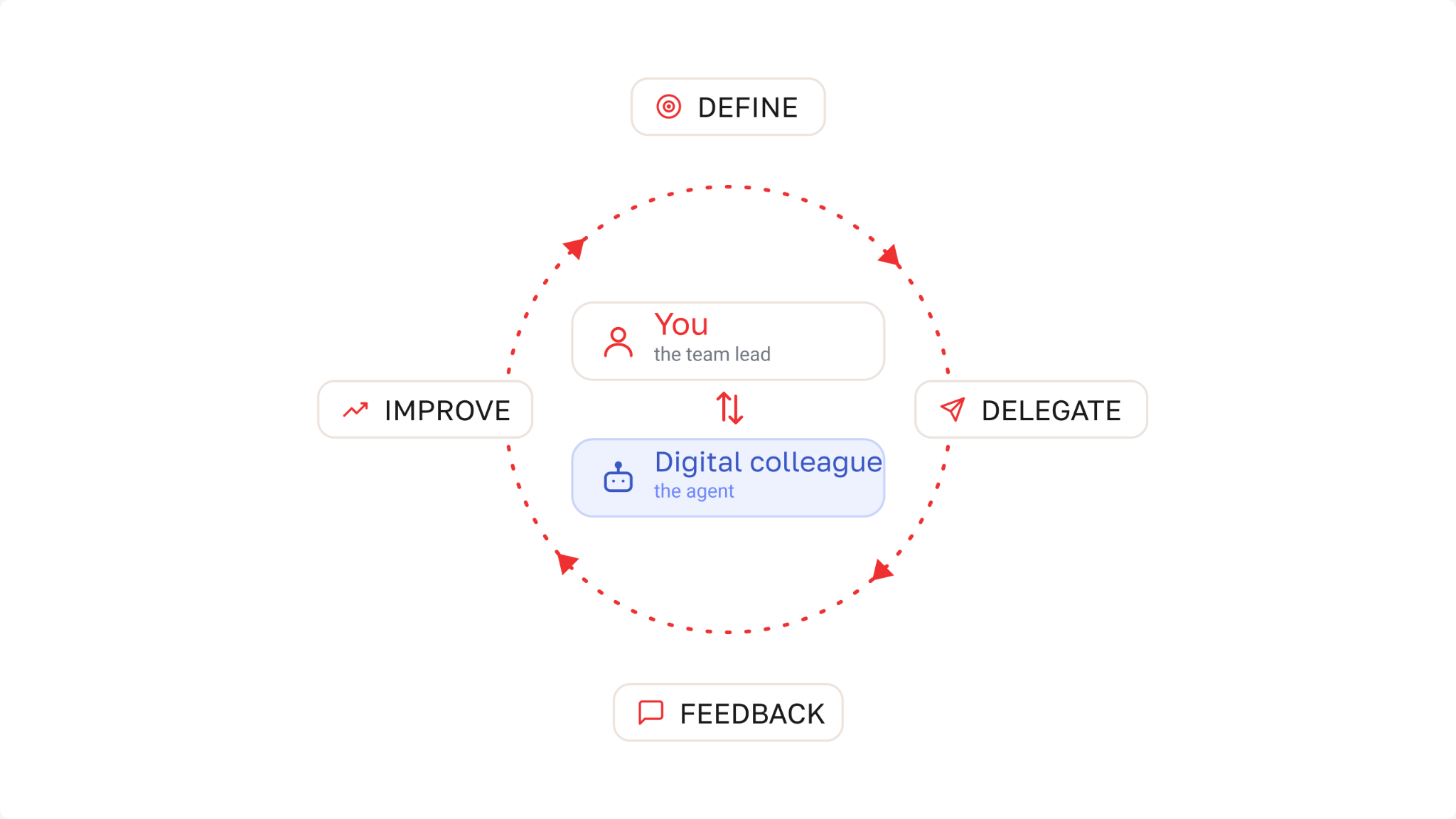
After this, we delved into where AI is already making a difference in recruitment – and where it sometimes creates more problems than it solves.
The use cases that genuinely move the needle – and that hold up even when you look closely at the data security and compliance requirements that responsible recruitment automation software needs to meet:
Job ads and role profiles. AI is great at drafting, translating, and optimizing job descriptions. There's no personal candidate data involved at this stage, which makes it both lower risk and a natural starting point for teams new to AI in hiring.
Candidate communication. The sheer volume of applications most companies receive today makes truly personalized communication impossible without AI. What used to require a superhuman recruiter – timely, individualized messages to every applicant – is now achievable at scale. The catch: a human still needs to review what goes out.
AI candidate screening and matching. AI can surface relevant candidates by cross-referencing structured data – years of experience, specific skills, tool familiarity – against a defined job profile. What it shouldn't do is make autonomous shortlisting decisions. There's a clear and important line between "AI highlights candidates who meet these criteria" and "AI decides who moves forward." The first is useful. The second is, as Oskari put it, a red flag.
Interview support. AI-assisted note-taking, structured interview question generation, and post-interview summaries can free recruiters from frantic multi-tab juggling – CV open in one tab, notes in another, calendar in a third. But note-takers come with a question: where does that data go? An interview is one of the most personal moments in a recruitment process. The data it generates needs to be handled accordingly.
General sparring and reporting. Think of AI as a 24/7 assistant that can answer questions about your pipeline, pull reporting data on demand, and help you prepare for conversations with candidates or hiring managers. The potential here is significant – and largely underutilized.
Early in the webinar, we put a statement to the room via Mentimeter:
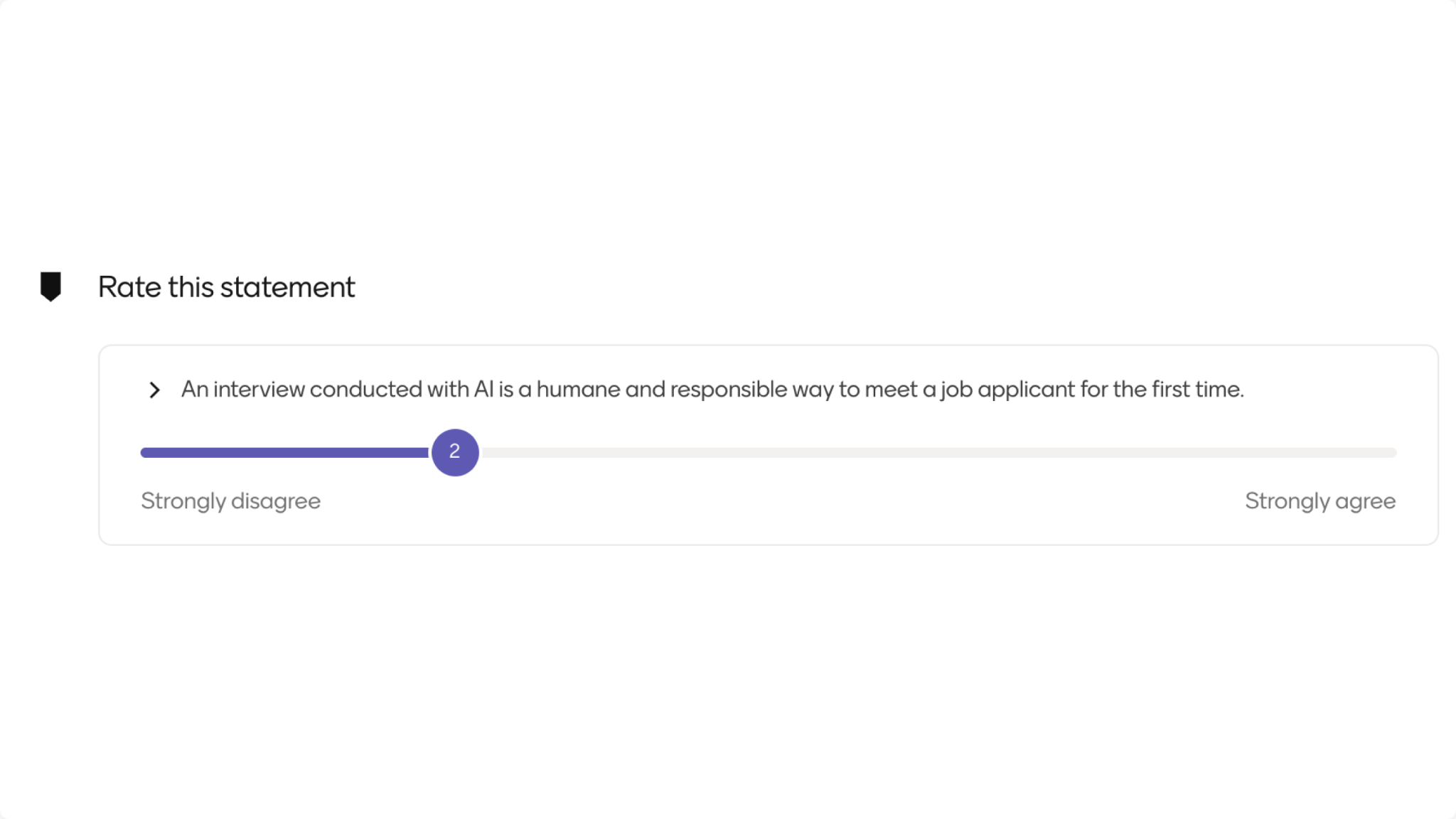
The average response landed at 2.0 out of 5 – firmly on the "strongly disagree" side. There are two legitimate sides to this debate: AI interviews can enable broader reach and more equitable access. But as the results suggest, most HR professionals still feel that something essential is lost when a machine replaces the first human moment in a hiring process. That instinct seems right to us.
The second major section tackled a topic that tends to make IT teams and legal departments uncomfortable: shadow AI.
A Technology at Work report found that 46% of office workers use AI tools at work that were not provided or approved by their employer. That number is probably higher today – and it extends fully into recruitment.
When a recruiter pastes a CV into an external LLM like ChatGPT to generate a summary, or uploads a stack of applications to a third-party screening tool, they may be:
This is compounded by what Oskari called the GPT-wrapper problem: AI tools that look purpose-built for HR but are, under the hood, simply piping your data to a generic LLM via an API – with no PII (Personally Identifiable Information) filtering, no EU data residency, and no meaningful way to delete the data later if a candidate requests it.
The shadow AI phenomenon isn't entirely the employee's fault. As Oskari observed:
"If you tell people they can't use AI, they'll find a way to use it anyway – because the amount of work isn't going down, and AI helps them keep up."
The answer isn't prohibition – it's giving people tools that are actually good, so they don't need to go looking for alternatives.
We asked attendees: "Has data security concern slowed your AI adoption in recruitment?"
The results were clear:
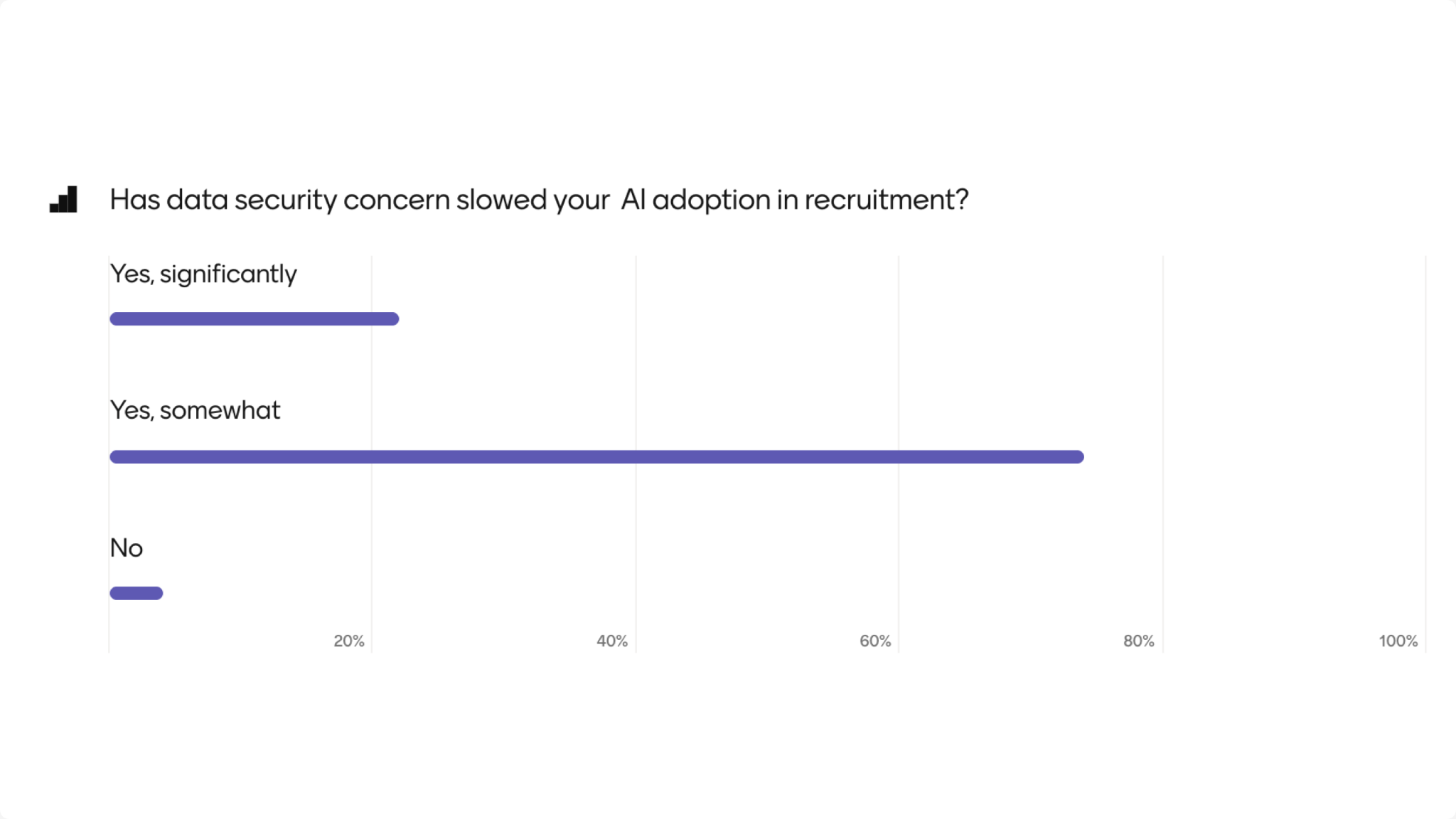
That's 96% of respondents saying data security is a real brake on adoption. This mirrors findings from Deloitte's Generative AI study, which identified data security as the biggest barrier to Gen AI adoption – cited by 67% of business leaders, ahead of data quality and model reliability.
Recruitment technology sits in one of the EU AI Act's most regulated categories: high-risk AI systems. That classification applies to AI used in employment decisions – screening, ranking, candidate matching, performance monitoring. It's just below "unacceptable risk" (which is prohibited outright) and well above the general-purpose tools that face minimal regulation.
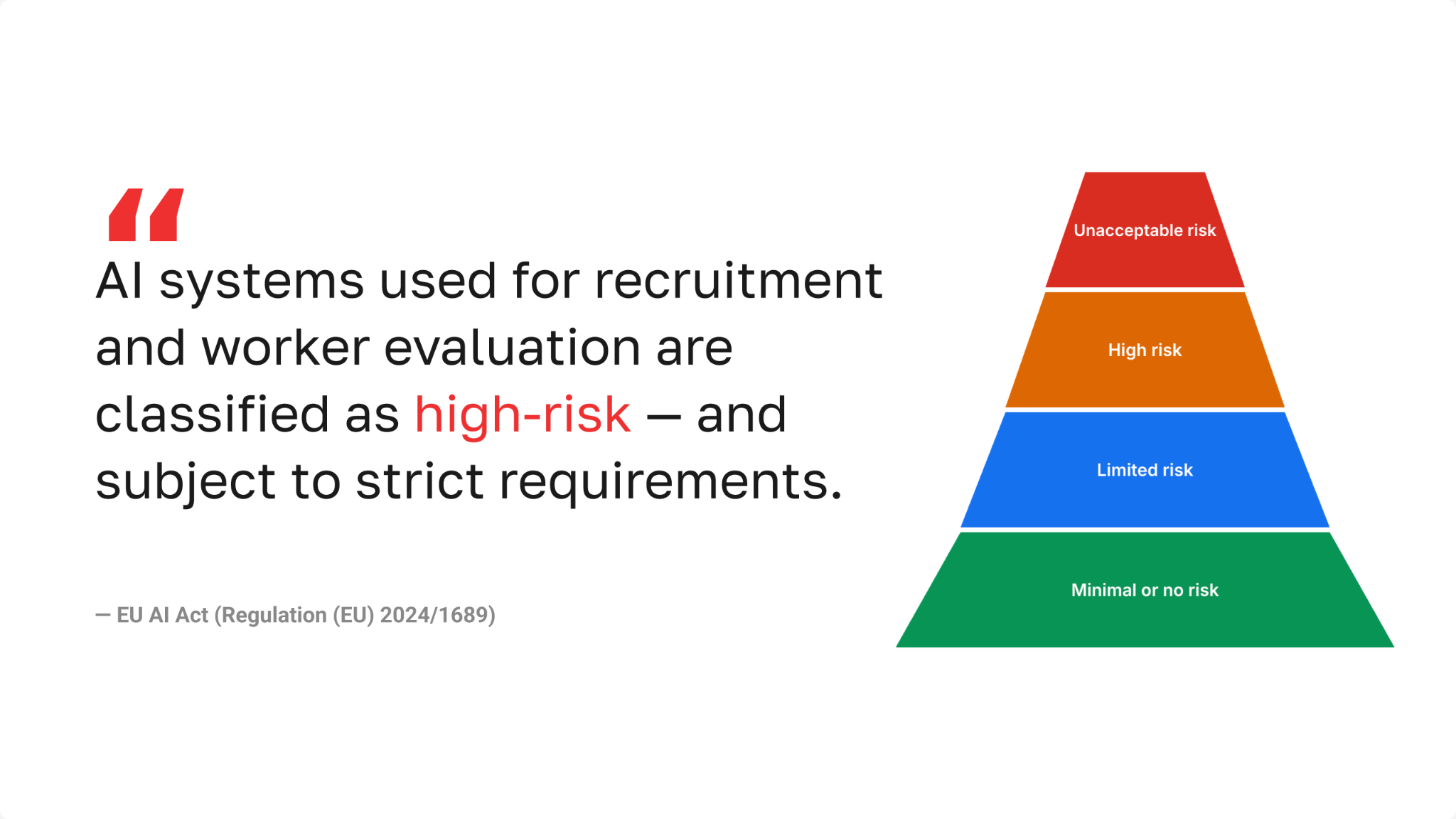
What does that mean in practice? A few things HR and TA teams need to understand:
Automated decision-making is prohibited. AI can assist and recommend, but a human must review and make final calls. Any vendor claiming their system makes automated hiring decisions should trigger serious scrutiny – not just because it's a legal risk, but because it's the wrong way to do recruitment.
Candidates have rights. Under Articles 13 and 26, candidates must be informed that AI is being used in the process. They also have a right to a human review of decisions that affect them, and to an explanation of how AI recommendations were made. These aren't just compliance checkboxes – they're basic fairness.
Transparency goes both ways. Your team should be able to explain how your AI tools work and what data they use. If a vendor can't tell you, that's your answer.
The May 2026 Omnibus VII agreement pushed the main enforcement deadline for Annex III (employment AI) from August 2026 to December 2027 – but AI literacy obligations have been in force since February 2025, and prohibitions on biometric and emotion-recognition tools in the workplace are already active. The deadline moved; the work didn't.
Oskari summarized TalentAdore's framework for responsible AI in recruitment around three principles.
1. Human in the loop – always. AI should never act as an autonomous gatekeeper in your process. Even when agents run automations, a human needs to be checking, approving, and course-correcting. The person is the driver. AI provides the data.
2. Transparency at every step. Know how your AI tools work. Know where the data goes. Be able to trace a recommendation back to the criteria and source data that produced it. If you can't audit it, you shouldn't be using it with candidate data.
3. Automate routines – not the moments that matter. Scheduling an interview is a logistics task. Conducting the interview is a human moment. The goal: free up human time for the moments that actually need it.
We received two strong questions in the Q&A that are worth sharing here.
Q: How does TalentAdore Hire help with EU AI Act compliance – specifically candidate notification (Art. 26(11)) and transparency & explainability (Art. 13(1))?
Oskari's answer: On notification, TalentAdore supports customers with built-in labeling when AI is being used in a recruitment process, and with privacy policy templates that clearly disclose AI usage and its scope. On explainability, the platform links AI recommendations back to their source – whether that's CV content, application form answers, or matching criteria. The AI doesn't give a recommendation without showing why, and it flags uncertainty rather than guessing.
Q: Candidates are using AI in interviews, and employers are using AI to interview. How do we manage this?
Janne and Oskari's take: The honest answer is that this is an evolving challenge – interesting to watch unfold. AI applying to jobs on behalf of candidates. AI screening those applications. AI-generated CVs with hallucinated experience. The response isn't to ban AI from the candidate side while using it freely on the employer side – that's a double standard candidates are increasingly calling out. The better path is designing your process so that human judgment still plays a meaningful role at the moments that matter: the interview, the decision, the relationship.
These are the principles Janne and Oskari left attendees with at the close of the session.
What is responsible AI in recruitment? Responsible AI in recruitment means using AI tools to support – not replace – human judgment in hiring. It involves transparency about when and how AI is used, keeping humans in the loop on final decisions, ensuring candidate data is handled securely and compliantly, and being able to explain how AI recommendations are made.
Is recruitment AI high-risk under the EU AI Act? Yes. The EU AI Act classifies AI used in employment decisions – including candidate screening, ranking, and matching – as high-risk (Annex III). These systems are subject to strict requirements around transparency, human oversight, logging, and documentation. The main Annex III enforcement deadline was extended to December 2027 under the May 2026 Omnibus VII agreement, but AI literacy obligations have applied since February 2025.
What are the risks of shadow AI in recruitment? Shadow AI refers to employees using AI tools that haven't been approved by their employer. In recruitment, this often means pasting CVs into consumer AI tools or using unvetted screening software – which can send candidate personal data to servers outside the EU, feed into models that train on your data, and create GDPR exposure the company doesn't even know about. The solution isn't banning AI; it's providing secure, approved alternatives.
What does "human in the loop" mean in recruitment? Human in the loop means that AI supports and informs decisions, but a human reviews and makes the final call. In recruitment, AI can surface matched candidates or flag concerns – but a recruiter or hiring manager must approve who moves forward. No autonomous AI gatekeeping.
How do I know if my AI hiring tools are GDPR-compliant? Key questions to ask any vendor: Where is data stored – EU servers or elsewhere? Does the system filter personally identifiable information before sending data to an AI model? Can you honor a candidate's right to deletion, completely? Can you explain how AI recommendations are made and trace them back to source data? If a vendor can't answer these clearly, that's your answer.
We've been developing AI for recruitment since 2016 – well before it was trendy. Our approach is guided by a principle we return to constantly: AI is a good servant, but a bad master.
TalentAdore Hire is GDPR-native, ISO 27001-certified, and built around a human-in-the-loop model: AI provides insights, your team makes the calls.
Want to see it in action? Book a demo.