Janne Malmisaari
•
Published
29.04.2026
•
10 min read
Picture this: you open your ATS five minutes before a hiring manager call. You scan the CV. You hunt for the latest interview notes. You try to remember which assessment was already done. You stitch a story together in your head while the meeting invite buzzes. By the time you're on the call, you're already half a step behind.

That moment – the frantic context-hunt – is exactly what most "AI features" in recruitment software fail to fix. A button to summarize here. A button to translate there. More tools that demand more clicks before they give anything back.
We know, because for a while, we built it that way too.
So when we rebuilt our AI Assistant and gave it a new name – Taika, the Finnish word for magic – we didn't want to ship another row of buttons. We wanted to strip the interface down so the recruiter could get back to the actual recruitment work.
I sat down with our Head of Product, Oskari Valkama, to walk through how he thinks about it.
"Good design is more than just adding a smarter interface – it is about removing the interface entirely. So the user can finally get back to their real work." – Oskari Valkama, Head of Product, TalentAdore
Ask a product builder what the easiest way is to solve a new user problem, and the honest answer is: bolt on a feature.
"When you are building a product, the easiest default is to solve a new user problem by simply bolting on a new feature," Oskari told me. "You add a button here, a new dashboard there, and before you know it, you have added so much visual noise that the workflows become unnecessarily complex."
He's blunt about TalentAdore's own past:
"I have to admit, we also built it that way in the beginning. We fell into the trap of building those scattered features. But by watching how people actually interacted with the tool, we realized this was not the right way to go."
What changed his mind wasn't a market study or a trending LinkedIn post. It was observing and asking how recruiters work. The pattern was clear: every new "AI feature" added cognitive load instead of removing it. Recruiters didn't want to manage more software. They wanted the software to support them.
That's where the rebuild started.
Recruitment work moves fast. You might be running five processes at once, each at a different stage, with different stakeholders asking for different things. Even with everything inside a single ATS, the real work is finding the right slice of context, right now – the latest assessment for one finalist, the screening notes for another, the rejected candidate from last quarter who suddenly looks like a fit again.
We've already done a lot of work on this from the structural side. CVs, applications, notes, and interactions sit in one application card. Our AI Notetaker, launched last year, takes interview notes off your plate entirely. So the data isn't scattered – it's all there. The challenge is the next layer: pulling the right context across views and cases, on demand, without making you do the digging yourself.
Oskari frames the frustration this way:
"It feels like these tools were not designed for humans. They force the user to act as the integration layer, doing the heavy lifting of manual data retrieval. If these tools do not work well for the people actually doing the hiring, then who do they work for?"
If you've ever flipped through five candidate cards trying to compare finalists, or tried to summarize three weeks of recruitment progress for a hiring manager who has ten minutes on their calendar, you know what he means.
There's also a less obvious version of the same problem – and a more dangerous one.
When an ATS doesn't help, recruiters improvise. Right now, "improvising" often means copy-pasting candidate data into ChatGPT or some other general-purpose LLM to draft a rejection email, summarize a CV, or compare profiles. It works in the moment. It also quietly sends sensitive personal data outside your GDPR-compliant systems, into a third party that (depending on the tool) may train on it. That's not a hypothetical. It's a candidate-trust problem dressed up as a productivity hack.
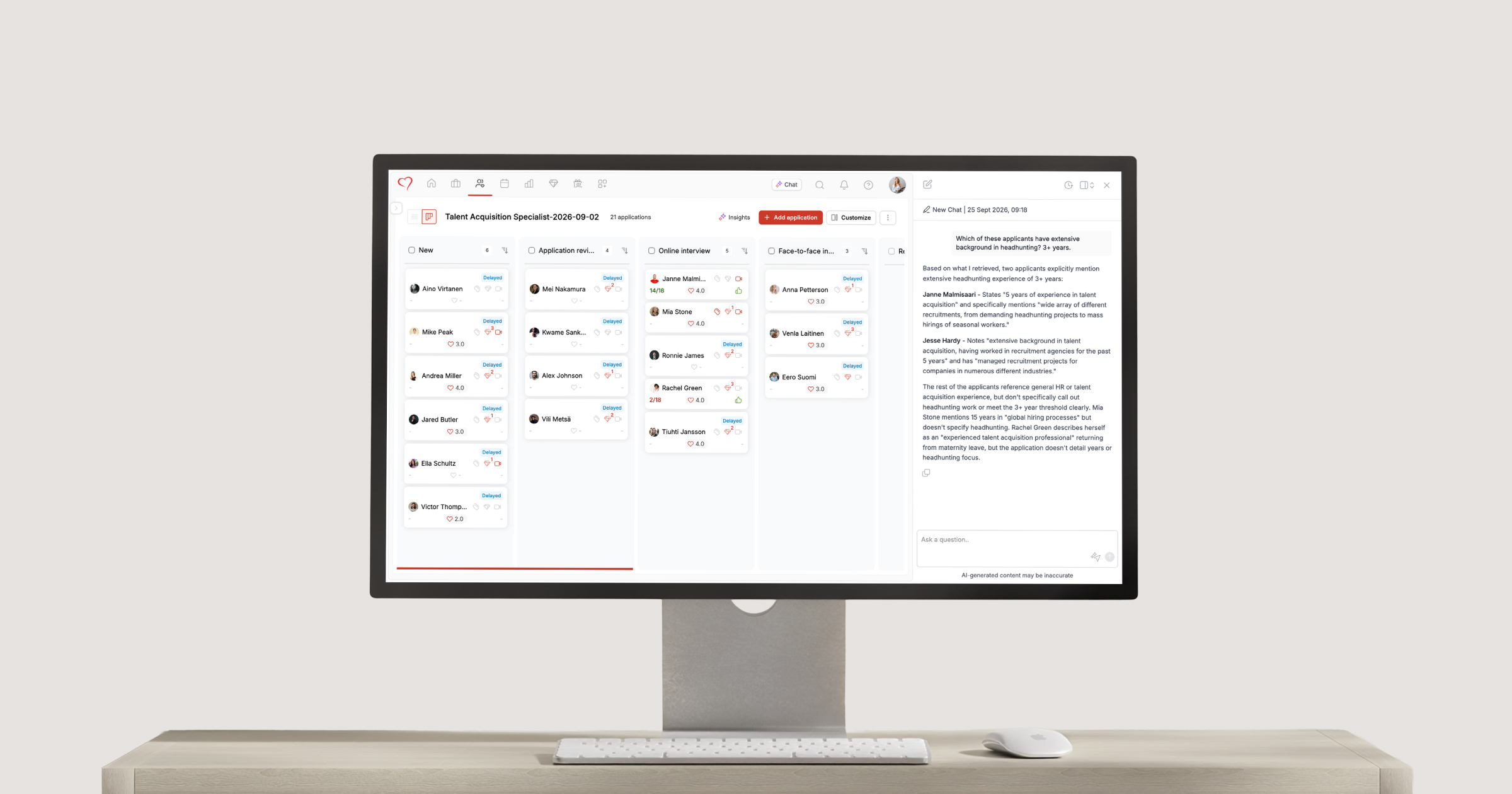
Taika exists so you don't have to choose between speed and safety. Because it lives natively inside TalentAdore Hire, it pulls from open positions, candidate profiles, interactions, and assessments without anything leaving the platform. So instead of clicking through five views – or worse, dropping candidate data into a chatbot you don't control – you just ask:
"What's happening with the Marketing Manager recruitment?"
And the brief shows up, drawn from your own data, on your own EU servers.

"Software should do the retrieving. The human should do the thinking."
That single sentence is the design principle behind Taika – and the practical effect is what most recruiters notice first. Time saved during those packed work days.
But the part we care about more is what happens with that time. When you're not scrambling for notes, you walk into the interview actually present. The candidate gets a real conversation, not a half-distracted one.
In other words: the time Taika saves doesn't just go back to the recruiter. It goes back to the candidate, too.
"Human empathy, intuition, and taste are the most critical components of building a team. You cannot code taste, and you should not try to automate human judgment."
Here's where Oskari's view gets sharp. The dominant trend in AI right now is full automation: replace the user, don't support them. He thinks that's the wrong question to be asking in the first place.
"Good software has to be opinionated," he said. "It needs to have a clear perspective on what it should do, and more importantly, what it should never do."
For Taika, the never-list is short and absolute:
The software will never make hiring decisions.
Taika will draft a candidate message. It will translate a job description. It will set up a two-way calendar sync. It will gather context and surface things you might otherwise miss. But every summary it produces lands on your desk for your review – not as a verdict.
"Human empathy, intuition, and taste are the most critical components of building a team. You cannot code taste, and you should not try to automate human judgment."
In recruiter terms: Taika never decides who to hire, who to reject, or how to weigh someone's experience. That's still your call. Taika just makes sure you have the time and the information to make it well.
This is the part the industry tends to get wrong. A lot of vendors talk about keeping a human in the process as a temporary safety measure – training wheels until the model gets good enough to take over. Oskari sees it the other way around.
"We view human-in-the-loop as a permanent, core design principle. Tools should amplify human intelligence rather than try to bypass it."
If you've read anything we've written about Responsible AI, you won't be surprised. But it's a point worth making explicitly: we treat the human staying in charge as an engineering principle, not a marketing position.
It's never been easier to launch an AI product. Hook your software up to someone else's AI service, slap a logo on it, ship it on a Tuesday. For a consumer toy, that might be fine. For software handling sensitive personal data of thousands of candidates? Not even close.
Oskari is direct about this:
"You cannot afford to treat security as an afterthought. If you want to build software for the long term, compliance cannot be something you figure out later."
In practice, this means Taika was never designed as a bolt-on. It runs natively inside TalentAdore Hire. Every interaction, every saved file, every AI-generated summary happens on our EU servers. The system is ISO 27001-certified, fully GDPR-compliant, and built to meet the standards of the EU AI Act from day one.
For you, that means a clean answer when a candidate, a hiring manager, or your data protection officer asks where their data lives or what's being done with it. Nothing leaves the platform. Nothing trains an outside model. There's no third-party tool to vet on top of TalentAdore Hire.
"Responsible AI is an engineering challenge, not a marketing checkbox. You cannot hack your way into enterprise trust."
We've talked before about skills-based hiring and what it takes to evaluate candidates fairly – and the same principle applies here. If your AI assistant isn't bias-aware, isn't auditable, and isn't keeping candidate data inside your jurisdiction, it isn't ready for recruitment work. Full stop.
"The ultimate goal of building software is not to create more interfaces for people to click through. It is to get the tool completely out of the way, so people can focus on the actual craft of their work."
When we landed on the name Taika, it wasn't a branding stunt. It was a small Finnish wink at what well-built software is supposed to feel like.
"We named our conversational UI Taika, which is the Finnish word for magic. But in product building, 'magic' isn't an illusion, a hype cycle, or a massive language model. Magic is simply the result of sweating the details for a very long time until all the friction is gone."
That "long time" matters. We've been building AI into our platform since 2014 – back when "AI in recruitment" wasn't an industry trend. A decade of watching real people use real tools is the difference between a tool that looks impressive in a 30-minute demo and one that quietly works for years.
Oskari's closing line is the one I keep coming back to:
"The ultimate goal of building software is not to create more interfaces for people to click through. It is to get the tool completely out of the way, so people can focus on the actual craft of their work."
That's Taika in one sentence. Not a smarter button. The brief you didn't have to dig for. The message you didn't have to retype. The meeting you walked into prepared, without spending fifteen minutes piecing context together first.
We'd much rather you spend that time talking to the candidate.
If "magic in the details" still sounds abstract, the easiest way to get it is to see Taika running inside an actual ATS.
Book a demo and we'll walk you through it – no scattered AI buttons, just one conversational assistant that already knows your recruitment context.
If you missed the original Taika launch story, you can catch up here: Meet Taika – your magical recruitment AI assistant.