How AI Matching Is Transforming Modern Recruitment

AI Matching can be used for automatically recommending the most suitable candidates for the company or a certain position. How does it work in practice?

02.05.2025
How AI Matching Is Transforming Modern Recruitment

<span style="font-weight: 400;">By using artificial intelligence to assess how well applicants align with job requirements, companies can streamline hiring, reduce bias, and make better decisions based on real skills and experience. AI matching plays a vital role in enabling effective <a href="https://talentadore.com/blog/skills-based-hiring-crash-course-on-definition-benefits-and-significance" target="_blank" rel="noopener">skills-based recruitment</a>.</span>
<blockquote><em><span style="font-weight: 400;">Instead of simply looking for keyword matches, advanced AI matching systems can understand context and meaning, making the process more intelligent and effective.</span></em></blockquote>
<strong>In this article, we’ll break down</strong>
<ul>
<li style="font-weight: 400;" aria-level="1"><span style="font-weight: 400;">How AI matching works</span></li>
<li style="font-weight: 400;" aria-level="1"><span style="font-weight: 400;">The main types of matching technologies</span></li>
<li style="font-weight: 400;" aria-level="1"><span style="font-weight: 400;">The benefits and challenges of AI in recruitment</span></li>
<li style="font-weight: 400;" aria-level="1"><span style="font-weight: 400;">How advanced solutions are shaping the future of hiring</span></li>
<li style="font-weight: 400;" aria-level="1"><span style="font-weight: 400;">Why investing in AI Matching is a strategic advantage</span></li>
</ul>
<h2><b>What Is AI Matching in Recruitment?</b></h2>
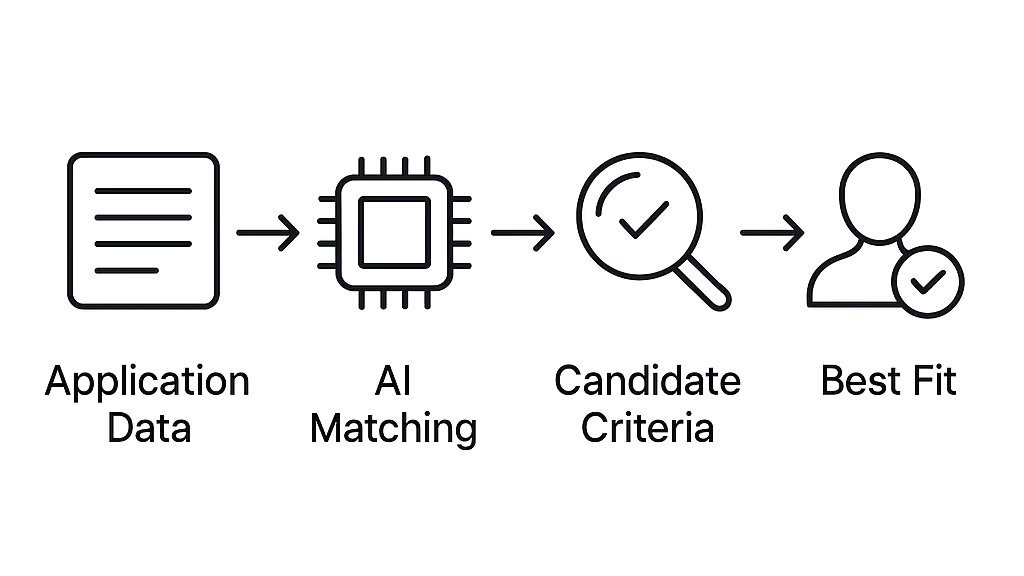
<span style="font-weight: 400;">AI matching refers to the process of using artificial intelligence to analyze and compare candidate profiles with job requirements. The goal is to automate and enhance the candidate screening process by identifying which applicants are most relevant for a given position.</span>

<span style="font-weight: 400;">This can include matching based on:</span>
<ul>
<li style="font-weight: 400;" aria-level="1"><span style="font-weight: 400;">Hard skills and qualifications</span></li>
<li style="font-weight: 400;" aria-level="1"><span style="font-weight: 400;">Work experience</span></li>
<li style="font-weight: 400;" aria-level="1"><span style="font-weight: 400;">Industry-specific terminology</span></li>
<li style="font-weight: 400;" aria-level="1"><span style="font-weight: 400;">Education and certifications</span></li>
<li style="font-weight: 400;" aria-level="1"><span style="font-weight: 400;">Semantically related concepts</span></li>
</ul>
<img class="alignleft size-full wp-image-26722" src="https://cms.talentadore.com/wp-content/uploads/2019/06/ai-matching-flow-transparent.png" alt="How AI Matching works" width="1024" height="576" />

<span style="font-weight: 400;">Instead of simply looking for keyword matches, advanced AI matching systems can understand context and meaning, making the process more intelligent and effective.</span>

<span style="font-weight: 400;">For instance, if you write that you’ve built </span><i><span style="font-weight: 400;">dashboards in Power BI</span></i><span style="font-weight: 400;">, the AI understands that you have data </span><i><span style="font-weight: 400;">visualization skills</span></i><span style="font-weight: 400;">—even if the job description only mentions “data visualization” and not Power BI specifically.</span>
<h2><b>Benefits and Challenges of AI Matching in Recruitment</b></h2>
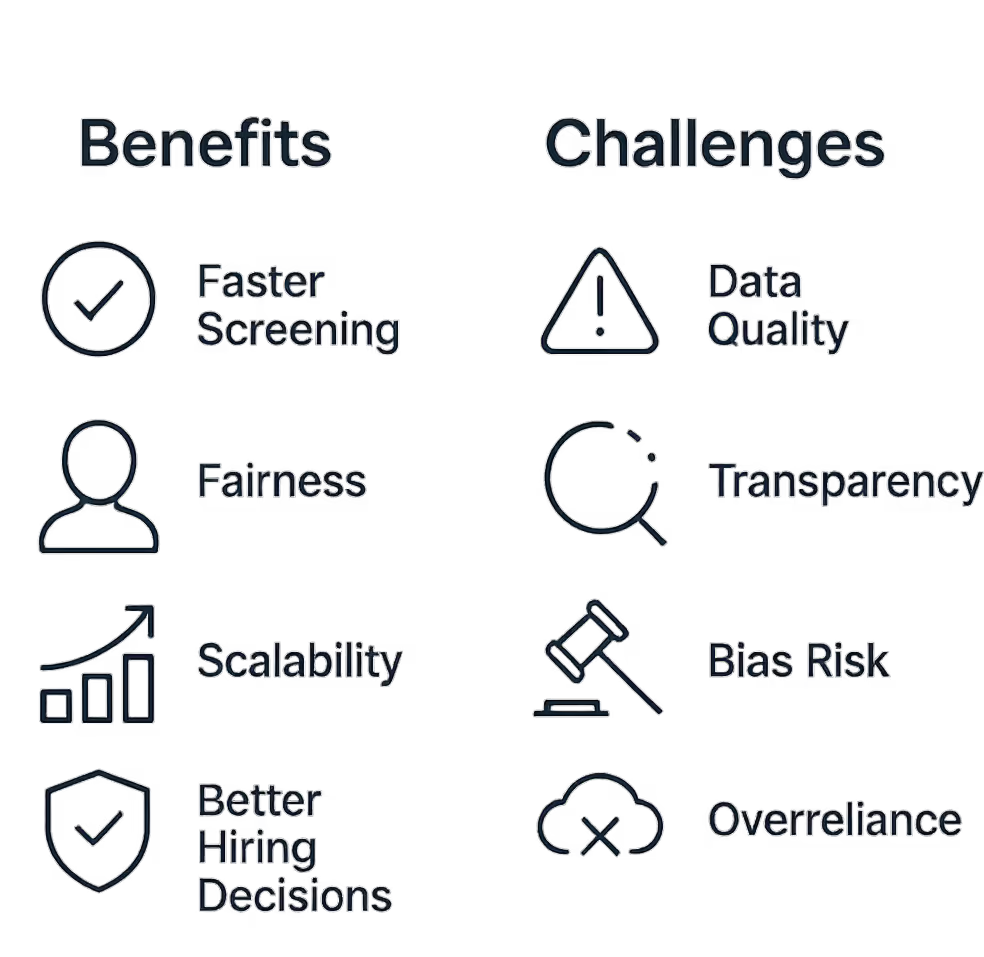
<h3><b>Benefits</b></h3>
<ul>
<li style="font-weight: 400;" aria-level="1"><b>Efficiency at Scale</b><b>
</b><span style="font-weight: 400;">AI matching reduces the time and manual effort involved in screening hundreds—or even thousands of applications. Recruiters can focus on top candidates faster.</span></li>
<li style="font-weight: 400;" aria-level="1"><b>Improved Quality of Hire</b><b>
</b><span style="font-weight: 400;">By aligning candidate strengths with role requirements using data-driven analysis, organizations can identify better fits for both skill and culture.</span></li>
<li style="font-weight: 400;" aria-level="1"><b>Fairness and Objectivity</b><b>
</b><span style="font-weight: 400;">AI can help minimize unconscious bias by focusing on skills and qualifications rather than personal identifiers such as names or demographics.</span></li>
<li style="font-weight: 400;" aria-level="1"><b>Consistency Across Roles</b><b>
</b><span style="font-weight: 400;">AI systems apply the same evaluation logic to every applicant, ensuring uniformity in how each profile is assessed.</span></li>
<li style="font-weight: 400;" aria-level="1"><b>Better Candidate Experience</b><b>
</b><span style="font-weight: 400;">Faster response times and relevant matches lead to a more respectful and engaging process for applicants.</span></li>
</ul>
<h3><b>Challenges</b></h3>
<ul>
<li style="font-weight: 400;" aria-level="1"><b>Data Quality and Context</b><b>
</b><span style="font-weight: 400;">If the data used by AI models (like resumes or job descriptions) is incomplete or unclear, the results can be misleading.</span></li>
<li style="font-weight: 400;" aria-level="1"><b>Overreliance on Automation</b><b>
</b><span style="font-weight: 400;">AI is a support tool, not a replacement for human judgment. Without oversight, there's a risk of false positives or missed opportunities.</span></li>
<li style="font-weight: 400;" aria-level="1"><b>Transparency and Trust</b><b>
</b><span style="font-weight: 400;">Candidates and recruiters must trust the AI’s decisions. This means ensuring every recommendation is auditable and explainable.</span></li>
<li style="font-weight: 400;" aria-level="1"><b>Bias in Training Data</b><b>
</b><span style="font-weight: 400;">AI models can inherit bias from the historical data they're trained on. Ongoing evaluation and improvement are essential to avoid reinforcing systemic inequalities.</span></li>
</ul>
<img class="alignleft size-full wp-image-26735" src="https://cms.talentadore.com/wp-content/uploads/2019/06/chatgpt-image-may-12-2025-04-38-14-pm-e1747123199485.png" alt="The benefits and challenge of AI Matching" width="984" height="957" />
<h2><b>Types of AI Matching Technologies</b></h2>
<span style="font-weight: 400;">AI matching in recruitment can involve several technological approaches, including:</span>
<ul>
<li style="font-weight: 400;" aria-level="1"><b>Keyword-Based Matching</b><b>
</b><span style="font-weight: 400;">This traditional method scans for direct word matches between resumes and job descriptions. It’s simple but can miss context.</span></li>
</ul>
Example: A job description includes the term “customer support”. The AI scans resumes for candidates who have used that exact phrase. A candidate who writes “helped users with product issues” might be missed because the exact keywords don’t match, even though the experience is relevant.
<ul>
<li style="font-weight: 400;" aria-level="1"><b>Semantic Matching</b><b>
</b><span style="font-weight: 400;">A more advanced method that understands the relationships between terms.</span></li>
</ul>
Example: A job requires “project management” skills. The AI recognizes that candidates mentioning tools like Trello, Asana, or phrases like “managed product roadmaps” are a semantic match, even if the words “project management” are never used directly.
<ul>
<li style="font-weight: 400;" aria-level="1"><b>Skill Extraction Engines</b><b>
</b><span style="font-weight: 400;">AI automatically identifies and categorizes hard skills from documents like resumes, cover letters, and application forms.</span></li>
</ul>
Example: Example: A candidate uploads a CV that says: “Proficient in Python, developed data analysis dashboards in Power BI.”The AI extracts structured skills like Python, Data Analysis, and Power BI, turning unstructured text into standardized skill tags.
<ul>
<li style="font-weight: 400;" aria-level="1"><b>Contextual Matching Using RAG (Retrieval-Augmented Generation)</b><b>
</b><span style="font-weight: 400;">AI leverages your organization’s historical recruitment data to tailor recommendations to your company’s unique hiring context.</span></li>
</ul>
Example: An organization has a history of hiring customer service reps with a background in hospitality. The AI, using past hiring data, recommends a candidate from the hotel industry—because the system has learned that this profile often succeeds in the role, even if it's not an obvious match.
<ul>
<li style="font-weight: 400;" aria-level="1"><b>Multi-Agent AI Systems</b><b>
</b><span style="font-weight: 400;">These involve multiple intelligent agents working together to handle complex matching tasks simultaneously, increasing accuracy and responsiveness.</span></li>
</ul>
Example: One AI agent analyzes hard skills, another evaluates past job titles, while a third assesses cultural fit based on sentiment in the cover letter. These agents collaborate in real time to produce a single ranked shortlist for the recruiter, handling volume and complexity efficiently.
<h2><b>How TalentAdore’s AI Matching Works (and What Makes It Stand Out)</b></h2>
<b>TalentAdore Hire’s AI Matching</b><span style="font-weight: 400;">, part of our </span><a href="https://talentadore.com/product/ai-assistant" target="_blank" rel="noopener"><b>AI Assistant</b></a><span style="font-weight: 400;">, is designed to address both the benefits and challenges of AI in recruitment. Here's how it works and what makes it different:</span>
<ul>
<li style="font-weight: 400;" aria-level="1"><b>Input Data Handling 📊</b><b>
</b><span style="font-weight: 400;"><span style="font-weight: 400;">Our AI uses all relevant candidate data, including structured fields from application forms, uploaded CVs, cover letters, and any additional responses - while strictly protecting privacy and following <a href="https://eur-lex.europa.eu/eli/reg/2016/679/oj/eng" target="_blank" rel="noopener">GDPR</a>.</span></span></li>
<li style="font-weight: 400;" aria-level="1"><b>Privacy by Design 🌈</b><b>
</b><span style="font-weight: 400;"><span style="font-weight: 400;">Personally identifiable information (like names, photos, addresses, etc.) is excluded from the matching process, ensuring candidates are evaluated solely on their qualifications and experience. This promotes fair evaluation and reduces bias.</span></span></li>
<li style="font-weight: 400;" aria-level="1"><b>Hard Skill Recognition ✨</b><b>
</b><span style="font-weight: 400;">The AI identifies hard skills from the documents and maps them against job requirements using systems such as ESCO</span><span style="font-weight: 400;"><span style="font-weight: 400;">, when applicable. Read below for more about ESCO.</span></span></li>
<li style="font-weight: 400;" aria-level="1"><b>Semantic Understanding 🧠</b><b>
</b><span style="font-weight: 400;">Instead of just matching keywords, our AI understands how different terms relate.</span></li>
<li style="font-weight: 400;" aria-level="1"><b>Human-in-the-Loop Design 👩‍💻</b><b>
</b><span style="font-weight: 400;"><span style="font-weight: 400;">Recruiters stay fully in control throughout the hiring process. AI provides just another data point for the recruiter to make decisions on. Thus, final judgments are always made by the recruiter, ensuring human oversight, accountability, and contextual understanding in every hire.</span></span></li>
<li style="font-weight: 400;" aria-level="1"><b>Secure and Compliant 🔒</b><b>
</b><span style="font-weight: 400;"><span style="font-weight: 400;">The system is built with strong data protection measures, ensuring compliance with recruitment regulations and privacy standards.</span></span></li>
<li style="font-weight: 400;" aria-level="1"><b>Traceability and Transparency 🤍</b><b>
</b><span style="font-weight: 400;"><span style="font-weight: 400;">Every decision made by the AI is auditable, helping to build trust with both hiring teams and candidates.</span></span></li>
<li style="font-weight: 400;" aria-level="1"><b>Multi-Agent System ⚡️</b><b>
</b><span style="font-weight: 400;"><span style="font-weight: 400;">Multiple AI assistants work together across different aspects of the hiring pipeline—boosting accuracy, speed, and reliability.</span></span></li>
<li style="font-weight: 400;" aria-level="1"><b>Scalable Architecture ♾️</b><b>
</b><span style="font-weight: 400;">Whether you're hiring for 10 roles or 10,000, our solution scales seamlessly to meet your needs, without loss of performance.</span></li>
</ul>
<img class="alignleft size-full wp-image-26751" src="https://cms.talentadore.com/wp-content/uploads/2019/06/skills-match-overlay.gif" alt="TalentAdore ATS AI Matching" width="1920" height="1080" />
<h2><b>Standardized Recruitment Ontologies for AI Matching</b></h2>
<span style="font-weight: 400;">To ensure accurate and meaningful candidate-role matching, AI systems benefit from structured classification systems that define the relationships between skills, occupations, and qualifications. Frameworks, like ESCO, serve as foundational ontologies that bring consistency to how roles and skills are understood across different countries and industries.</span>

<span style="font-weight: 400;">These networks act as shared languages that help recruitment technologies interpret candidate data and job requirements in a standardized, comparable way, enabling more precise and fair AI-driven decision-making.</span>
<h3><span style="font-weight: 400;">What is an ESCO?</span></h3>
<span style="font-weight: 400;"><strong><a href="https://esco.ec.europa.eu/en/about-esco/what-esco" target="_blank" rel="noopener">ESCO (European Skills, Competences, Qualifications and Occupations)</a></strong> is a multilingual classification system that covers skills, competencies, qualifications, and occupations. The goal of ESCO is to build a common reference terminology and ontological description to help the European labor market become more effective and integrated, and enable worlds of work, education, and training to communicate more effectively with one another.</span>

<span style="font-weight: 400;">ESCO is also linked to relevant international classification frameworks, such as the International Standard Classification of Occupations and the European Qualifications Framework. ESCO is a key resource in the Europe 2020 and New Skills Agenda for Europe’s strategic EU projects. Additionally, national employment projects in Finland, such as Työmarkkinatori, utilize ESCO as their backbone for standardizing recruitment, further incentivizing the implementation of ESCO.</span>
<h2><b>Why Investing in AI Matching Is a Strategic Advantage</b></h2>
<span style="font-weight: 400;">Adopting </span><b>AI matching in recruitment</b><span style="font-weight: 400;"> isn’t just about keeping up with technological trends. It’s a strategic decision that directly impacts hiring quality, employer brand, and operational efficiency.</span>

<span style="font-weight: 400;">As talent markets become more competitive and candidate expectations rise, companies need smarter tools to stay ahead. AI matching allows organizations to consistently surface the right talent faster, reduce bias, and provide a more seamless experience for both candidates and recruiters.</span>

<span style="font-weight: 400;">Moreover, companies that build AI into their recruitment workflows now are setting the foundation for even more advanced capabilities in the future—like predictive analytics, talent pooling, and automated career pathing. With scalable, transparent, and privacy-compliant AI matching in place, your hiring team is better equipped not just for today’s needs, but for long-term success in a dynamic job market.</span>
<h2><b>Conclusion</b></h2>
<span style="font-weight: 400;">AI matching is not just a trend—it’s becoming an essential part of modern recruitment. While the technology must be implemented thoughtfully, the potential to improve efficiency, fairness, and decision-making is significant.</span>

<b>TalentAdore Hire’s AI Matching</b><span style="font-weight: 400;"> brings these benefits to life through advanced semantic analysis, human-centered design, and secure, future-ready architecture. Whether you're looking to streamline high-volume hiring or find better matches for niche roles, our AI-powered solution helps you recruit smarter and without sacrificing control or transparency. <strong><a href="https://info.talentadore.com/en/ats" target="_blank" rel="noopener">Request a demo to learn more.</a></strong></span>

<em>This blog post was originally published in June 2019 and updated in May 2025.</em>

Resources

More from the content hub

No items found.
Boka en demo

Lär dig hur det fungerar